
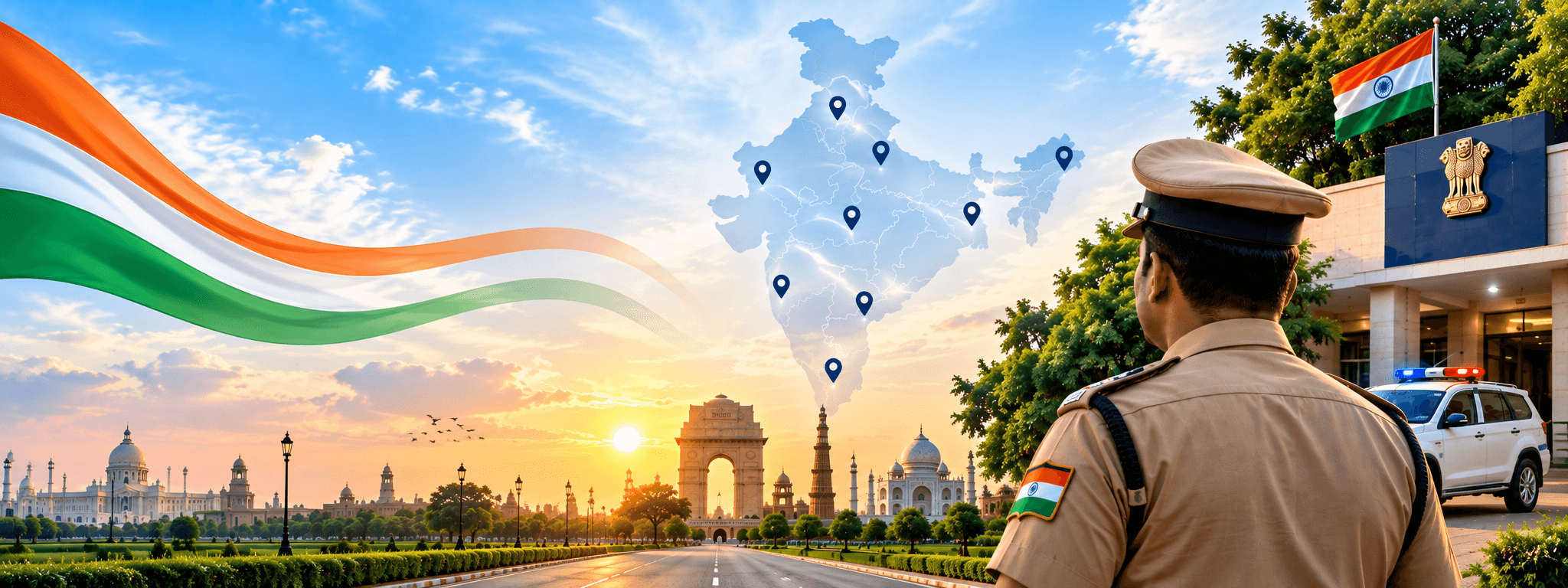
Find Police Stations
Across India
Phone numbers, addresses and directions for 564 police stations across all 36 states and union territories — searchable by city, locality or PIN code.
564
Stations indexed
36
States & UTs
700+
Districts covered
Free
Always free to use
Find the Nearest Police Station to You
Use your device's GPS to instantly discover police stations near your current location — complete with phone numbers, addresses, and one-click directions. Your location is never stored or shared.
- Works on any smartphone or computer
- Shows distance and directions
- Phone number to call instantly
- Location data stays in your browser only
Nearest station found
Live map · distance · phone · directions
Emergency Helplines – Available 24/7
In an emergency, call these numbers immediately. Do not search — call now.
Police Stations by State
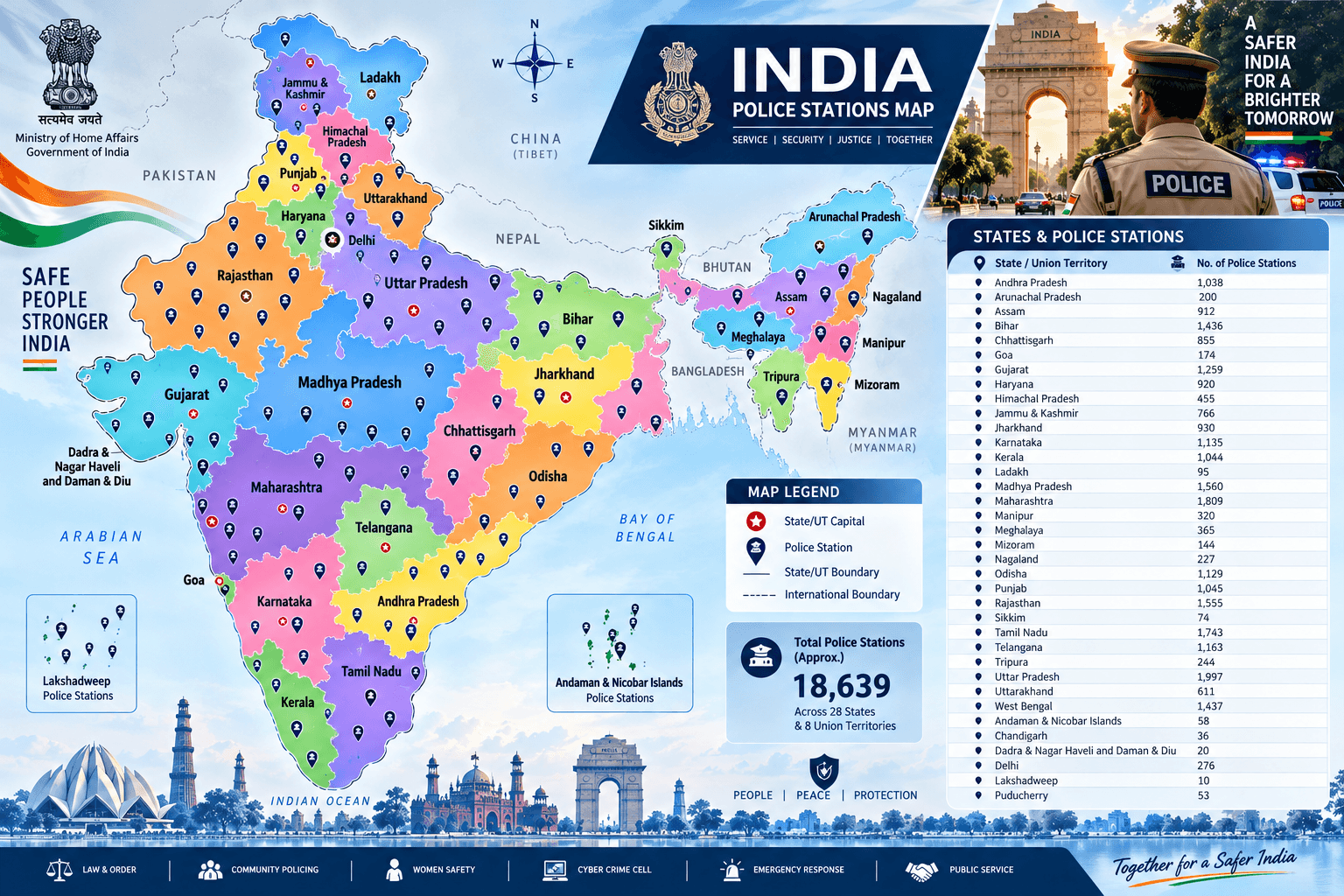
Browse the complete directory of police stations for each of India's 28 states and 8 union territories. Find station lists, contact numbers, and local emergency resources.
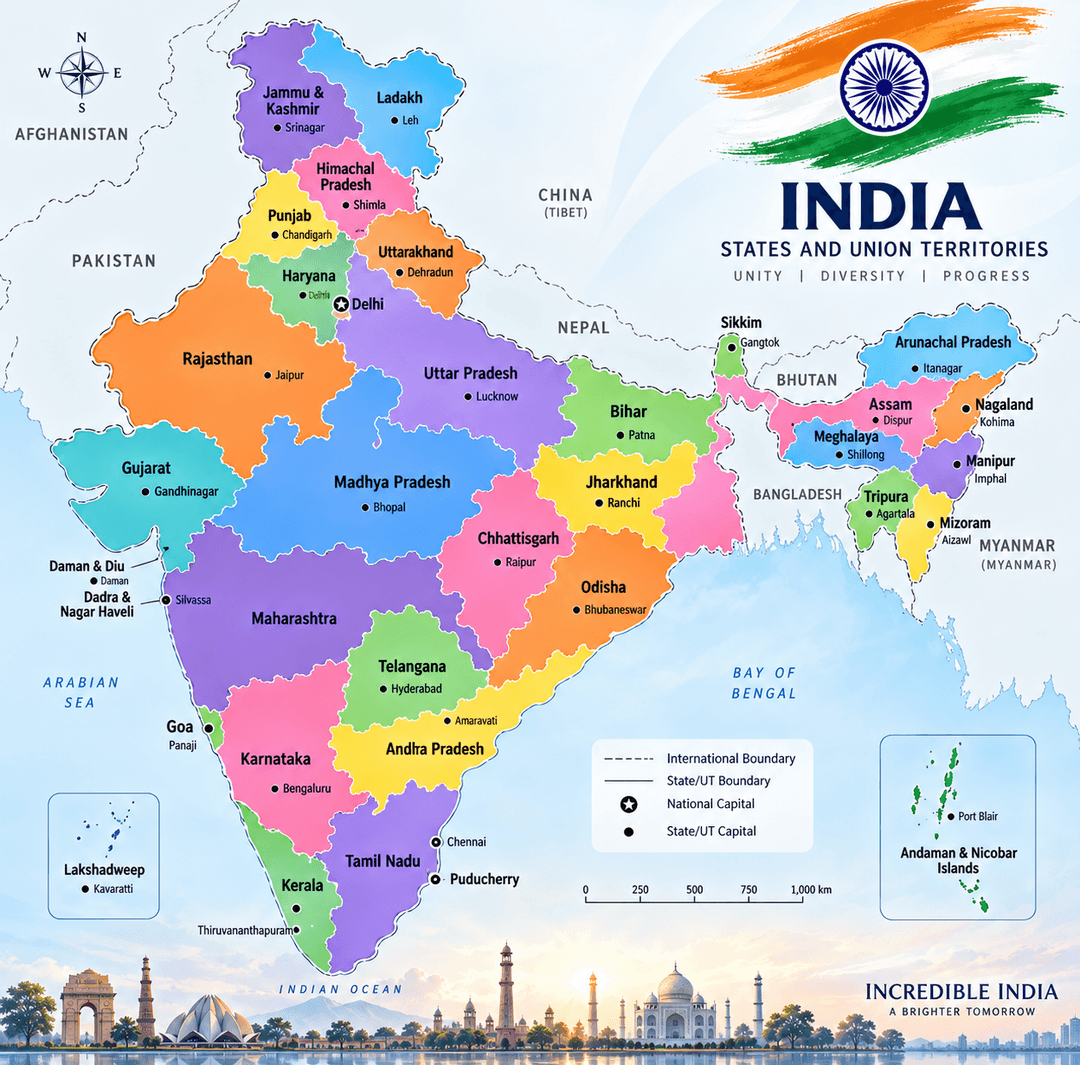
States
Andhra Pradesh
38 listed
Arunachal Pradesh
7 listed
Assam
12 listed
Bihar
12 listed
Chhattisgarh
9 listed
Goa
7 listed
Gujarat
12 listed
Haryana
12 listed
Himachal Pradesh
8 listed
Jharkhand
8 listed
Karnataka
44 listed
Kerala
33 listed
Madhya Pradesh
16 listed
Maharashtra
24 listed
Manipur
5 listed
Meghalaya
11 listed
Mizoram
4 listed
Nagaland
6 listed
Odisha
16 listed
Punjab
23 listed
Rajasthan
21 listed
Sikkim
6 listed
Tamil Nadu
39 listed
Telangana
29 listed
Tripura
7 listed
Uttar Pradesh
27 listed
Uttarakhand
11 listed
West Bengal
73 listed
Union Territories
Police Stations – Verified Listings
Phone numbers and addresses verified from official state police sources.
Connaught Place Police Station
Connaught Place, New Delhi
011-23341337
Chanakyapuri Police Station
Chanakyapuri, New Delhi
011-24672233
Andheri Police Station
Andheri West, Mumbai, Maharashtra
022-26268888
Bandra Police Station
Bandra West, Mumbai, Maharashtra
022-26553855
Lalbazar Police Station
1 Shakespeare Sarani, Kolkata
033-22141414
Koramangala Police Station
80 Feet Road, Koramangala, Bengaluru
080-25530290
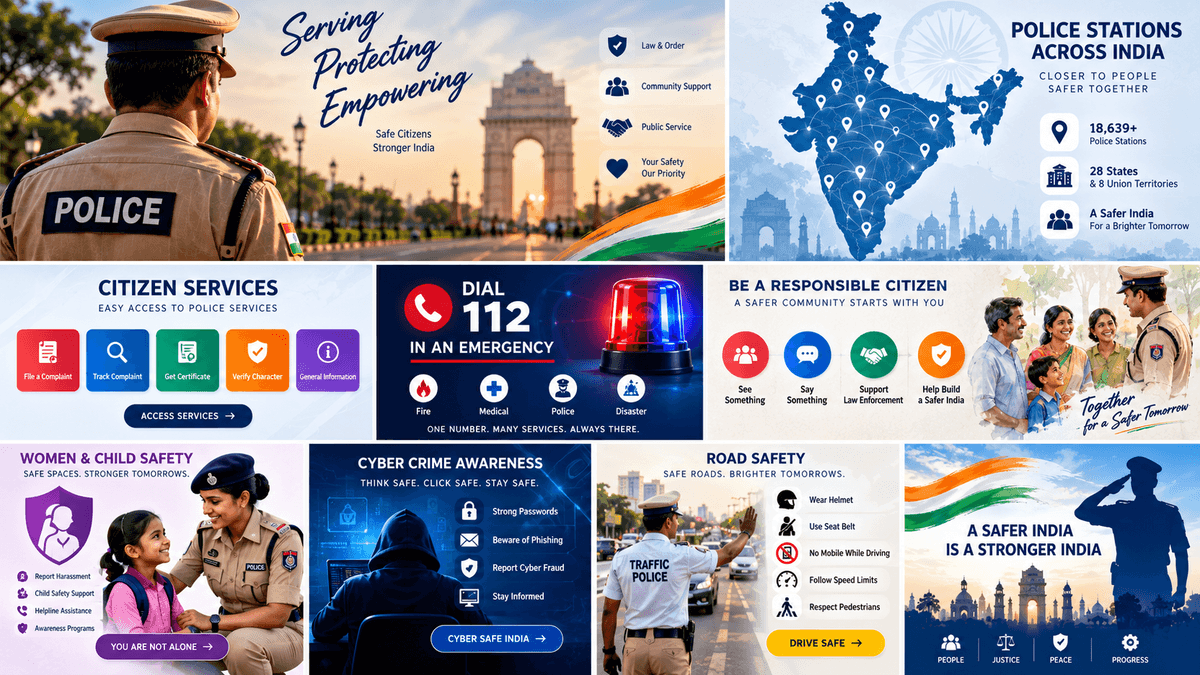
What is NC in a Police Station?
NC (Non-Cognizable Report) is a complaint filed at a police station for minor offences where police cannot arrest without a court warrant. It differs from an FIR (First Information Report), which is for cognizable offences.
When to file NC
Minor disputes, simple hurt, trespassing, defamation, verbal abuse
What happens after NC
Police record it and may forward to a magistrate. The aggrieved party can also file a private complaint in court.
NC vs FIR
FIR = cognizable (serious) offences. NC = non-cognizable (minor) offences. Police must take both seriously.
How to Contact Your Nearest Police Station
Whether it's an emergency, complaint, or general inquiry — here's how to reach your local police station effectively.
- 1
In an Emergency
Call 100 (Police) or 112 (Unified Emergency) immediately. Don't search the web — call now.
- 2
Find Your Station
Use this directory to find your local station's phone number by searching your area or PIN code.
- 3
Call or Visit
Call the station's number directly to check availability or visit in person for complaints requiring physical presence.
- 4
File Your Complaint
For cognizable offences, insist on an FIR. For minor offences, an NC report will be filed. Get a copy of the report.
Citizen Services at Police Stations
Police stations in India provide a wide range of public services beyond just emergencies. Know what you can do at your local station.
File an FIR
Lodge a First Information Report for cognizable offences at your nearest station.
NC Report
File a Non-Cognizable report for minor disputes, trespassing or simple hurt.
Passport Verification
Police verification required for new passport applicants is done at local stations.
Lost Property
Report lost documents, phones or valuables at the nearest police station.
Tenant Verification
Landlords and tenants can get police verification done at the local station.
Cybercrime Report
Report online fraud, cyber stalking or financial cybercrime at a police station.

Dedicated Helplines for Women & Children
India has dedicated helpline numbers and police cells for women and children in distress. All police stations must register complaints related to violence against women and provide immediate assistance.
Women Helpline
24/7 helpline for women in distress, domestic violence, harassment
Child Helpline (CHILDLINE)
For children in need of care and protection
Women Helpline (Domestic Abuse)
Dedicated number for domestic violence cases
Emergency SOS
Fastest route to police, ambulance or fire brigade
Report Cybercrime & Online Fraud
Cybercrime cases — including online fraud, digital harassment, identity theft and phishing — can be reported at any police station or directly through the national cybercrime portal.
Helpline
1930
National Cybercrime Helpline — report online financial fraud
Portal
cybercrime.gov.in
File cybercrime complaint online 24/7
In Person
Local Police Station
Visit any police station with evidence (screenshots, bank statements)
Know Your Rights at a Police Station
Every citizen has the right to fair treatment at a police station. Understanding your legal rights protects you and helps police do their job effectively.
Right to a copy of your FIR
Police must give you a free copy of any FIR you file. Insist on it.
Right to know why you are arrested
Police must tell you the reason for arrest immediately.
Right to legal counsel
You have the right to contact a lawyer and family member if arrested.
Right against custodial torture
No police officer can physically harm you in custody. It is illegal.
Right to medical examination
If arrested, you are entitled to a medical examination by a government doctor.
The Most Complete Police Station Directory for India
PoliceStationsIndia.com is built to help every Indian citizen quickly find official police station contact information, no matter where they are in the country.
22,000+
Stations Indexed
36
States & UTs
700+
Districts
Free
Always Free
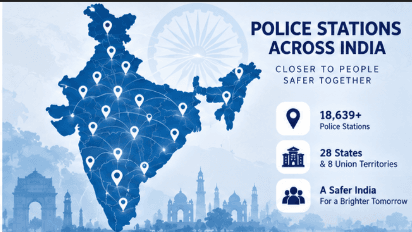
Who Is in Charge of a Police Station in India?
Policing in India is a State subject under the Seventh Schedule, so the force serving India is raised, paid for and commanded by the state government rather than by Delhi. the state police sets its own recruitment rules, postings and internal procedure, even though the criminal law it enforces is national.
At the top sits the Director General of Police, reporting to the state Home Department. Below the DGP the force fans out into zones, ranges and districts. A district is commanded by a Superintendent of Police; in larger cities that becomes a Commissionerate, where a Commissioner holds both policing and magisterial powers — which is why a metro officer is a DCP rather than an SP.
None of that hierarchy is what you actually deal with. The police station is. Every square metre of India falls inside exactly one station's jurisdiction, and that station is the entry point for almost every interaction you will have with the police — reporting a crime, getting a document verified, or recovering lost property.
A station is commanded by a Station House Officer — an Inspector in cities, a Sub-Inspector in smaller towns. Both ranks can register an FIR, so being told to “come back when the SHO is here” is not a lawful reason to delay a cognizable offence. Below them are ASIs, Head Constables and Constables; the constable assigned to your neighbourhood is the beat officer who will visit for passport or tenant verification.
How Do I File an FIR across India?
The First Information Report is the hinge on which any criminal case turns. It is recorded under Section 173 of the Bharatiya Nagarik Suraksha Sanhita, 2023, which replaced Section 154 of the old Code of Criminal Procedure. Until an FIR exists the police have no legal basis to investigate, arrest, or seize evidence.
Only a cognizable offence gets an FIR. "Cognizable" means grave enough that an officer may arrest without first obtaining a warrant. Theft, burglary, assault causing hurt, kidnapping, rioting and murder all qualify. For anything less serious a station in India records a Non-Cognizable entry instead.
You need no lawyer, no stamp paper, no written application and no fee. Walk in, tell the duty officer what happened, and they must write it down, read it back to you in a language you understand, and take your signature or thumb impression.
The one thing never to skip is your free copy. Section 173(2) BNSS entitles every informant to a copy at no cost — anyone asking you to pay is acting unlawfully. Note the FIR number, the date and the recording officer's name; you will need all three for insurance, for court, and for every follow-up. If a station refuses outright, our complaint guide sets out the escalation route to the SP and then to a magistrate.
What to state
Date, time and exact place, what was done and by whom, the value of anything lost, and any injury caused.
After filing
Keep the copy safe, note the Investigating Officer's name and number, and ask when to check back on progress.
Language rights
Your statement must be recorded in a language you understand and read back before you sign. Ask for this — it is not optional.
Getting updates
Under the 2023 codes you are entitled to a progress update within ninety days. Most state portals also allow status lookup by FIR number.
NC or FIR — Which One Applies to My Complaint?
NC stands for Non-Cognizable, and no other piece of station vocabulary causes as much confusion. An NC is a formal register entry recording that you reported something — for an offence where police cannot investigate or arrest without a magistrate's permission.
The distinction turns on the seriousness of the offence, not on how upset you are. Minor assault without injury, public nuisance, defamation, simple trespass and most neighbour disputes are non-cognizable. Because the power to arrest is a serious intrusion, the law reserves it for graver crimes.
In practice most NCs filed in India are not disputes at all — they are lost property. The copy you receive is what your insurer, bank, the RTO or the passport office will demand before issuing a duplicate. Our lost and found guide covers what to do for each document type.
If a station says your matter is “only an NC” but you believe a cognizable offence occurred, say so politely and ask for the refusal in writing. You can then escalate to the Superintendent of Police, or apply to a magistrate under Section 175(3) BNSS.
Commonly filed as an NC
- Missing vehicle registration or insurance papers
- A lost cheque book or bank passbook
- A lost passport, PAN card or driving licence
- Lost academic certificates or mark sheets
- A minor boundary or parking dispute with a neighbour
| Aspect | FIR (Cognizable) | NC (Non-Cognizable) |
|---|---|---|
| Investigation starts | Immediately | Only after a magistrate's order |
| Court permission needed | No | Yes |
| Governing provision | Sec. 173 BNSS | Sec. 174 BNSS |
| Arrest without warrant | Permitted | Not permitted |
| Free copy for you | Yes — legally guaranteed | Yes — always ask for it |
| Typical offences | Theft, assault, burglary, fraud, kidnapping | Lost property, nuisance, minor disputes, defamation |
What Actually Happens Inside a Police Station?
A police station is not one undifferentiated room. Knowing which desk does what gets you to the right person faster.
The front desk is staffed continuously, including at night and on holidays. The duty officer there is your first contact for everything. If unsure whom to see, start here.
The writer or record room keeps the registers: FIR, NC, the general diary logging every event of the day, and the roznamcha recording officers' movements. Your free copy is produced here.
The malkhana is the secured store for seized and recovered property — where anything of yours sits until a court orders its release on superdari. The lock-up holds people in custody, never beyond twenty-four hours without a magistrate, never women overnight without a woman constable, and never a juvenile.
Most stations are busiest between ten and one. If your matter is not urgent, arriving early or late afternoon means a shorter wait — or skip the trip and check which station is actually closest to you first.
Do I Have to Go to the Station Nearest the Crime?
Every police station in India is assigned a defined geographical area — its jurisdiction. As a rule the station covering the place where the incident happened is the one that investigates, not the station nearest your home.
It is the commonest reason people are sent away from a station and give up. A bag stolen on a train belongs to the Government Railway Police for that section of track. A car broken into in a mall car park belongs to the station covering the mall, even if you live thirty kilometres away. Online fraud follows where the loss occurred — generally wherever you are in India.
Zero FIR removes the burden of working this out. Introduced after the Justice Verma Committee, it lets you register an FIR at any station regardless of jurisdiction. The station numbers it zero, records the complaint in full, takes urgent action such as a medical examination, then transfers the file onward.
A station refusing a Zero FIR is not exercising discretion — it is committing an offence under Section 199 BNS, and for sexual offences that carries up to two years. The practical takeaway: in an emergency go to whichever station you can reach fastest. Sorting out jurisdiction is the police's job, not yours.
What Should I Do in the First Hour After Being Scammed?
Nothing reported in India rewards speed the way cyber fraud does. Money leaving your account passes through mule accounts within minutes. Once withdrawn as cash or converted to crypto, recovery is close to impossible.
That is why 1930 exists. Run under the Indian Cyber Crime Coordination Centre, it plugs into the system that can send a freeze instruction to the receiving bank in near real time. That window is the golden hour.
Call 1930 first — before your bank, before posting about it, before going to a station. Have the transaction ID, amount, time and your account number ready. Follow with a written complaint at cybercrime.gov.in, which returns a trackable acknowledgement number.
You may also report at any station in India. None may refuse for want of a cyber cell or because the offender is in another state — the loss occurred where you are. Our cybercrime reporting guide walks through the evidence to preserve.
Sextortion
Threats to publish intimate images. Report it — the law protects you and your identity is not disclosed.
Investment fraud
Trading and crypto groups promising guaranteed returns, usually run through messaging apps.
Digital arrest scam
Callers posing as police, CBI or customs claiming you are implicated and demanding money. No agency works this way.
Job and task scams
Small payments for 'tasks' that build trust before a large deposit is demanded and vanishes.
What Should a Woman Know Before Going to a Police Station in India?
The protections Indian law extends to women and children go substantially further than the ordinary rules, and every station in India must honour them. Knowing they exist is often the difference between a complaint being taken seriously and being talked out of the door.
For women
- Zero FIR applies fully — any station must record the complaint regardless of jurisdiction.
- Every station must run a Women's Helpdesk, staffed by a woman officer wherever posting strength allows.
- Medical examination is free at any government or private hospital under Section 397 BNSS.
- A statement about a sexual offence must be recorded by a woman officer, at a place of the survivor's choosing — including her home.
- A woman cannot be arrested between sunset and sunrise without a magistrate's written permission.
For children
- Children in conflict with the law go before the Juvenile Justice Board, never a regular lock-up.
- Details of a child victim may not be published in any form, including on social media.
- A child's statement should be recorded at home or another place where the child feels safe.
- The officer recording a POCSO statement must not be in uniform, and the child must never be made to meet the accused.
- A missing child must be registered as an FIR immediately, on the presumption of kidnapping or trafficking.
Helplines: 1091 women's helpline, 181 domestic abuse, 1098 CHILDLINE, 112 any emergency. All free, all twenty-four hours, all working from a phone with no balance. See every emergency number explained.
What Verification Services Can I Get across India?
For the majority of residents in India, the only reason they ever deal with police is paperwork: the check underpinning passports, tenancies and job offers. Knowing how it runs in India will save you weeks. Our guide to contacting the police covers what to prepare for each type.
Event and protest permission
Public gatherings, processions and loudspeaker use need prior permission from the local station or DCP office.
Domestic staff checks
Verification of drivers, cooks and security staff is mandatory in several states. Most urban forces now accept this online.
Passport verification
Triggered when you apply at a Passport Seva Kendra. The beat officer visits your address — keep Aadhaar, a utility bill and any rental agreement ready.
Police Clearance Certificate
States you have no adverse record — required by most immigration authorities. Apply via Passport Seva, not the station directly.
Verification is a free government service. No officer may charge for visiting your address or issuing a report. If asked for money, report it to the state Anti-Corruption Bureau or Vigilance Commission — see our sources and methodology.
Do My Rights Change Inside a Police Station?
Nothing about being inside a police station reduces the Constitution's protection. Articles 20 and 21, reinforced by the Supreme Court in D.K. Basu v. State of West Bengal (1997), protect every person in India — complainant, witness or arrested person alike, and whether you are in India or anywhere else.
On arrest the officer must state the grounds, wear visible identification of name and rank, and prepare an arrest memo attested by a family member or a respectable local person, recording the time and place. You may have one friend or relative informed.
You must be produced before a magistrate within twenty-four hours excluding travel. Custody beyond that needs judicial authorisation. You may meet a lawyer of your choice during interrogation, and receive a medical examination every forty-eight hours.
Women cannot be arrested before sunrise or after sunset without a magistrate's prior written permission, and any arrest or search of a woman must be by a woman officer — see our women's safety guide. Anyone under eighteen goes before the Juvenile Justice Board, never an ordinary lock-up.
As a complainant, Section 179 BNSS matters too: a woman, anyone under fifteen or over sixty, and anyone with a disability or acute illness cannot be compelled to attend a station outside their district. In those cases the police must come to you.
Which Laws Govern the Police in India?
On 1 July 2024 three statutes replaced the backbone of Indian criminal law. The Bharatiya Nyaya Sanhita replaced the Indian Penal Code of 1860, the Bharatiya Nagarik Suraksha Sanhita replaced the Criminal Procedure Code of 1973, and the Bharatiya Sakshya Adhiniyam replaced the Evidence Act of 1872.
For most citizens the practical effect is modest — theft is still theft — but the section numbers people had memorised are gone. The FIR provision everyone knew as Section 154 CrPC is now Section 173 BNSS; Section 156(3), used to force registration through a magistrate, is now Section 175(3). Older guidance online will have the numbers wrong even where the substance is right.
The new codes add real obligations. Zero FIR and e-FIR are now written into statute rather than resting on court directions. Forensic examination is compulsory for offences carrying seven years or more. Investigations must finish within ninety days for most offences, and the informant is entitled to a progress update in the same period.
Alongside sits the Police Act framework. The colonial 1861 Act still forms the base, though most states have their own acts following Prakash Singh v. Union of India (2006), which required Police Complaints Authorities, minimum tenure for key officers, and separation of investigation from law-and-order duties. If you believe an officer abused their position, that Authority is the designated forum — our help guides set out how to approach it.
What Do People Get Wrong across India?
Waiting to 'gather more proof'
You do not need a complete case to report. Police have investigative powers you do not — delay only loses evidence.
Not noting the officer's details
Record the name, rank and buckle number of whoever handles your matter. Every escalation route asks for it.
Believing the 24-hour myth
There is no waiting period before reporting a missing person. Any station saying otherwise is wrong, and for a child it is seriously wrong.
Paying for a free service
FIRs, NCs, copies and verification are all free. Any demand for money is itself reportable to the Anti-Corruption Bureau.
Leaving without your free copy
Both an FIR and an NC entitle you to a copy at no cost. Without it you cannot claim insurance, apply for duplicates, or prove you reported anything.
Signing something you have not read
Never sign a blank sheet or a statement not read back to you in a language you understand. You are entitled to both.
None of this is legal advice. For a matter already in court, or a serious allegation against you, speak to a qualified advocate. Free legal aid is available to every woman, every child and anyone below the income threshold through the District Legal Services Authority — start with our help guides.
A Plain-English Glossary of Police Vocabulary
- Panchnama
- A record of a seizure or inspection, signed by independent witnesses.
- Cognizable
- An offence serious enough that police may arrest without a warrant and investigate without a court order.
- Beat officer
- The constable responsible for your neighbourhood, who conducts address verification.
- BNS / BNSS
- The 2023 codes replacing the IPC and CrPC.
- FIR
- First Information Report — the document opening a criminal investigation into a cognizable offence.
- Closure report
- Filed when police find no evidence. You have the right to be heard before a court accepts it.
- Malkhana
- The station's secured store for seized and recovered property.
- Zero FIR
- An FIR registered outside the jurisdiction where the offence occurred, then transferred to the correct station.
- SHO
- Station House Officer — the Inspector or Sub-Inspector commanding a police station.
- PCC
- Police Clearance Certificate — proof of no adverse record, usually needed for visas and overseas jobs.
- Chargesheet
- The final report police file in court once investigation ends, naming the accused and the evidence.
- NC
- Non-Cognizable report — an entry for a minor offence where police need a magistrate's order to investigate.
More terms and step-by-step walkthroughs are in our help and safety guides.
Related Guides for India
Police Stations in India – Questions People Ask Most
Answers to the questions people most often search for about police stations, FIRs, NC reports, helplines and citizen rights in India.
How do I find the nearest police station to my location?
Use the Find Near Me tool, allow your browser's location prompt, and the nearest stations appear on a live map sorted by distance, each with its phone number and turn-by-turn directions. Your GPS position is used inside your browser only — it is never sent to a server or stored.
Find a police station near meWhat is NC in a police station?
NC stands for Non-Cognizable. It is a formal entry in the station register for a minor offence — one where police cannot investigate or arrest without a magistrate's order. In practice most NCs are filed for lost property: a phone, wallet, passport, driving licence or vehicle documents. You receive a free copy, and that copy is what banks, insurers, the RTO and the passport office require before issuing a duplicate.
Full NC and FIR guideWhat is the police emergency number in India?
Dial 100 for police or 112 for the unified emergency number that reaches police, fire and ambulance. Both are free from any phone, including one with no balance or no SIM. For women's safety call 1091, for children 1098, and for cyber financial fraud 1930.
All emergency helplines explainedCan the police refuse to register my FIR?
No. For a cognizable offence the police are legally bound to register an FIR under Section 173 BNSS and have no discretion to refuse. If a station does refuse, ask for the refusal in writing, send a written complaint to the Superintendent of Police by registered post, and if that fails apply directly to a magistrate under Section 175(3) BNSS.
What to do if police refuse an FIRIs PoliceStationsIndia.com an official government website?
No. PoliceStationsIndia.com is an independent public information directory, not affiliated with any police force, state government or central government. We cannot register complaints or forward anything to the police. For official information always check your state police's own website.
About this directoryAre police station phone numbers on this site free to use?
Yes. The entire directory is free, requires no sign-up, and carries no advertising. Calling a station costs whatever your telephone operator charges for a normal call. Emergency numbers such as 100, 112, 1091, 1098 and 1930 are free from any phone.
Where our data comes fromCan I file a police complaint online in India?
Partly. Cybercrime can be reported online at cybercrime.gov.in for the whole country. Many state police portals additionally accept online reports for lost documents, stolen vehicles and tenant verification. A full FIR for a serious offence still generally requires attending the station in person so your statement can be recorded and read back to you.
Find your state police portalWhat should I carry when visiting a police station?
Bring a government photo ID such as Aadhaar, a driving licence, voter card or passport, along with any documents relating to your matter — bills, receipts, agreements, photographs or screenshots — and the contact details of any witnesses. Writing a short dated summary of events beforehand makes the visit considerably faster.
Preparing for a station visitHow many police stations are there in India?
There are roughly 17,000 to 22,000 police stations across India depending on whether outposts, railway stations and specialised units are counted. The figure changes constantly as new stations are notified and jurisdictions are reorganised. Our directory covers all 36 states and union territories and more than 700 districts.
Browse all states and union territoriesHow long does police verification take for a passport?
Typically seven to twenty-one days, depending on the state and how busy the local station is. The file reaches the station covering your address and a beat constable visits to confirm you live there. Having Aadhaar, a utility bill and any rental agreement ready shortens the visit considerably. Anyone who has moved within the past year should expect verification at both addresses.
Police verification explainedDo I have to wait 24 hours to report a missing person?
No. The twenty-four hour waiting period is a myth with no basis in Indian law. A missing-person report must be registered immediately, and where the missing person is under eighteen the police must register an FIR straight away on the presumption of kidnapping and upload the details to the TrackChild portal.
Reporting a missing personHow do I search for a police station by PIN code?
Enter your six-digit PIN code in the search bar and the directory returns the stations indexed for that postal area, along with the city and district they belong to. PIN code search is usually the fastest route when you know the postal code of an address but not which station covers it.
Search by PIN code, city or station nameWhat is the difference between a cognizable and a non-cognizable offence?
A cognizable offence — theft, burglary, assault causing hurt, rape, kidnapping, murder — is serious enough that police may arrest without a warrant and begin investigating immediately on an FIR. A non-cognizable offence such as defamation, public nuisance or simple trespass requires a magistrate's order before police may investigate, and is recorded as an NC entry instead.
Cognizable vs non-cognizable explainedCan a woman be called to a police station for questioning?
Not outside the place she resides. Under Section 179 BNSS a woman, a person under fifteen, anyone over sixty, and anyone with a disability or acute illness cannot be compelled to attend a police station away from where they live. In those cases the police must come to you.
Women's safety and legal protectionsImportant Disclaimer
PoliceStationsIndia.com is an independent public information directory and is not affiliated with any government authority. Information is compiled from public sources for general awareness only. Always verify critical details directly with the police station. In emergencies, call 100 or 112 immediately.